I received a complimentary copy of this in exchange for an honest review as a member of the Bible Gateway Blogger Grid. All reviews are my honest opinions based on my experience with the product. #BibleGatewayPartner
Is the New Testament for Everyone by N.T. Wright a trustworthy translation of the Bible?
I am extra careful when I evaluate new Bible translations, as well as when I review a Bible, and even more so when I am reviewing a Bible that is not typical. The New Testament for Everyone by N.T. Wright checks all of those boxes. It is a newer, less common translation, it is a Bible, but it is what I would label an abnormal Bible. On top of all of those factors, the New Testament for Everyone was translated by one person on their own. If you are like me, that’s a bonus item added to the “reasons to be skeptical” list.
With that said, this translation is published by Zondervan, a trusted Bible publisher, and is now available on the top Bible website, BibleGateway.com. That should add some credibility to the material, right? Well, let’s walk through the New Testament for Everyone by N.T. Wright with a look into N.T. Wright, a peek at how he translated the NTFE translation, and then a comparison of the NTFE to other popular translations.
Who is N.T. Wright?
Nicholas Thomas Wright, known as N.T. Wright, is an English New Testament scholar, Pauline theologian, and has served as the Bishop of Durham in the Church of England. He has written over 70 books, and has his own translation of the New Testament, the Kingdom New Testament, which later bred the NTFE (New Testament for Everyone). You can find more than 30 online courses, certifications, ebooks, and blog articles on his website (also available on a new site) where it states that believers can “Learn from the world-renowned Prof. Wright by engaging a variety of resources”. His works have been controversial to the degree that other renown Bible scholars, such as John Piper, have written their own books to dispute the teachings of N.T. Wright.
A red flag for me is that no matter what I look up concerning N.T. Wright, I find complaints, controversy, and warnings. There is not a lot of material that defends Wright and his works. Of course, this does not mean that all of the complaints and warnings are accurate, but anytime I find a lot of controversy around a Bible scholar I stop and ask some questions, as should we all.
How and why did N.T. Wright Translate the New Testament?
N.T. Wright translated the New Testament from the original Greek into “easily readable modern English, aiming for both accuracy and accessibility.” (BibleGateway.com). Wright used his own study and understanding of the New Testament as a Bible scholar and theologian to translate the New Testament for Everyone Bible translation. Usually, Bible translations are completed by a team of scholars translating together based on an agreed upon goal, set of translation “rules”, and principles.
Wright’s philosophy for translation is that each generation should have a new translation while also taking into account previously completed translations. In the Preface of the New Testament for Everyone, he gives credit to one of his “lifelong heroes, William Tindale” and then goes on to explain what kind of translation NTFE is by saying;
“Some have been quite strict translations, almost word for word; others have been paraphrases, trying to convey the message in a looser, less formal way. Two questions, then: is this new version really a translation, or a paraphrase? And why do we need yet another one?”
He then states plainly that the NTFE is a translation, not a paraphrase. For those of you who don’t know, William Tyndale was responsible for beginning the work of translating the Bible into English when Henry VIII was King of England and had separated England from the Roman Catholic Church making himself the Head of the Church of England. Tyndale began a dangerous project of secretly translating the scriptures into English, which was forbidden by the Pope, but eventually opened the door for common people to read the Bible for themselves for the first time. N.T. Wright sees what Tyndale did, and seems to desire to carry the torch onward for common people to have a translation they can easily understand, just as Tyndale worked at providing a Bible in English so the common people could understand the Word of God in their own language.
N.T. Wright points out time and again how language evolves over time, making new translation important to the development of our culture, so that there is always a translation that each generation will be able to read and make sense of without deciphering outdated linguistics. The NTFE translation is designed to be as word-for-word as possible, but with first-century Greek being so vastly different from modern English, he basically explains that there is no way to match it up word-for-word at all, let alone in a way that would make any sense. So, he veers away from the literal verbatim translation in order to capture what the original writer seems to intend to say. With this, I give him credit for his honesty in disclosing that no translation of the Bible is truly “safe”, and that all of them are “risky” – but that it is a necessary risk so that we can understand God’s Word.
How is the New Testament for Everyone meant to be used?
One thing I want to mention is that the goal of the New Testament for Everyone by N.T. Wright is to provide a fresh, modern translation of the Bible in English. It is intended to be used alongside other translations, but namely it was originally designed, per the Preface of the New Testament for Everyone, to accompany N.T. Wright’s commentary series’ on the New Testament which was made for people who have no intention of reading Bible commentaries. This is not a translation that is acclaimed to be the end-all for believers – it is intended to be a companion translation, but again namely a companion to Wright’s own commentaries.
N.T. Wright encourages Bible readers to go beyond the translations we have grown comfortable with, and step into a new way of wording the same message. With that, though, Wright does not want you to stop here with the NTFE – he makes it crystal clear that as the world changes, and the English language evolves, translations should evolve as well to ensure that we have a Bible in our own language that makes sense to us at any point in history.
Additionally, the New Testament for Everyone is also designed to be read more like a novel. I actually really appreciate that this Bible is laid out in a way sort of halfway between novel, which lacks verse references etc, and a traditional Bible with all the references. It has verse numbers and subtitles to guide readers, but it is still setup to flow like a novel. It makes me think of the Eternity Now: New Testament Series. Eternity Now is the Bible, but legitimately in novel form.
Layout of the NTFE
NTFE’s layout and style is a mesh of this and a traditional Bible, which gives you a different experience while reading it. I can sit and read it like a novel with less distraction, and less of a temptation to stop at breaks I normally would in my Bible, but I can also use the verse numbers and subtitles to guide me and reference where I am. The intention behind this is to give the Bible reader a flexible reading experience, which also enables us to study scripture with more flexibility and ease.
NTFE vs. NKJV
One way I find helpful to evaluate a translation is to compare to other translations. The NKJV (New King James Version) is my favorite primary translation. As we are approaching Christmas, I wanted to take a look at Luke 2 and read about the birth of Jesus Christ. The very first thing I noticed is that Luke 2:1-2 already differs from a variety of other translations I checked. (Emphasis mine.)
And it came to pass in those days that a decree went out from Caesar Augustus that all the world should be registered. 2 This census first took place while Quirinius was governing Syria. Luke 2:1-2 NKJV
At that time a decree was issued by Augustus Caesar: a census was to be taken of the whole world. 2 (This was the first census, before the one when Quirinius was governor of Syria.) Luke 2:1-2 NTFE
While every translation I read (NLT, ESV, NIV, KJV, CSB, AMP, NET) stated that the census was WHILE Augustus Caesar was governor, NTFE states that it was “BEFORE the one” when he was governor. Maybe not a huge deal, not worth splitting hairs over maybe, but this now changes the timeline of events a bit and strikes me that it is a small detail that is clearly different than so many other translations.
In Luke 2:10, the angel of the Lord appears to the shepherds and speaks to them. This shows us another noticeable difference for the NTFE, which is again translated more as a novel. Where there are conversations, they will read more like you would read a conversation in you favorite novel than what you are accustomed to in scripture. Additionally, frequently where you would read “Christ” in most translations, the NTFE reads as “Messiah”, which Wright points out in the Preface is how Christos is literally translated.
10 Then the angel said to them, “Do not be afraid, for behold, I bring you good tidings of great joy which will be to all people. 11 For there is born to you this day in the city of David a Savior, who is Christ the Lord. 12 And this will be the sign to you: You will find a Babe wrapped in swaddling cloths, lying in a manger.”
13 And suddenly there was with the angel a multitude of the heavenly host praising God and saying:
10 “Don’t be afraid,” the angel said to them. “Look: I’ve got good news for you, news which will make everybody very happy. 11 Today a savior has been born for you—the Messiah, the Lord!—in David’s town. 12 This will be the sign for you: you’ll find the baby wrapped up, and lying in a feeding-trough.”
13 Suddenly, with the angel, there was a crowd of the heavenly armies. They were praising God, saying,
Right away, there are some pretty noticeable differences. Of course, the point of new translations is to be different in some way or another, while holding true to the original message as much as possible. The New Testament for Everyone has the flow and style of a novel, but it also changes some things that are most often translated particular ways. Sometimes this may be a bigger issue while other times, like above, it is not something I would quantify as a salvation issue.
Another noteworthy verse, though, is Matthew 18:11 where Jesus is telling the parable of the Lost Sheep. Verse 11 is included in many translations, yet is left out in the NTFE. This verse, I would argue, is important because it does talk about salvation. So, its exclusion is something to dive into.
10 “Take heed that you do not despise one of these little ones, for I say to you that in heaven their angels always see the face of My Father who is in heaven. 11 For the Son of Man has come to save that which was lost.
12 “What do you think? If a man has a hundred sheep, and one of them goes astray, does he not leave the ninety-nine and go to the mountains to seek the one that is straying? 13 And if he should find it, assuredly, I say to you, he rejoices more over that sheep than over the ninety-nine that did not go astray. 14 Even so it is not the will of your Father who is in heaven that one of these little ones should perish. Matthew 18:10-14 NKJV (Emphasis mine.)
10 “Take care not to despise one of these little ones. I tell you this: in heaven, their angels are always gazing on the face of my father who lives there.
12 “How does it seem to you? If someone has a hundred sheep and one of them wanders off and goes missing, what will he do? He’ll leave the ninety-nine on the hillside and go off after the one that’s missing, won’t he? 13 And when, eventually, he finds it, I’ll tell you the truth: he will celebrate over that one more than over the ninety-nine who didn’t go missing! 14 It’s the same with your father in heaven. The last thing he wants is for a single one of these little ones to be lost.” Matthew 18:10-14 NTFE
Matthew 18:11 is said to have been added here from the story of Zacchaeus the Tax Collector in Luke 19:10. Some manuscripts have it in Matthew here, and some do not. This leads to some translations including it, and some not. The main thing here is that yes, this verse is in other places in scripture, and the message and lesson is in other places in the Bible. It is difficult for translators to determine what manuscripts to go by, and what ones not to. The Preface of the NTFE explains a bit more about how N.T. Wright made these difficult calls, as well as why there are no footnotes to let us know when something has been left out like many other translations include. Essentially, it boiled down to lessening distractions, and going with what appeared to be the most reliable manuscripts available to date – not all of which were available when many of the translations we have in English were being translated.
Do I recommend the New Testament for Everyone?
Personally, the NTFE feels so deprived of the deep, poetic language of most translations of the Bible that the modernization of the English used in the NTFE feels overly casual. I find it hard to take it as seriously as I do many other translations, and where N.T. Wright’s goal was to better capture the original meanings of what was being written it feels more like he took much of the meaning and significance away from the Word. It is so “modernized” that it reads with even less depth than translations intended for children, such as the ICB or the ESV.
Overall, the New Testament for Everyone is designed to be used by those who need the Bible in very modernized, easy-to-read language and reading style. It is meant for those who have a hard time reading other modern translations, or who want some help studying the Bible for the first time. The NTFE is a translation might be helpful to someone who is just starting out with the Bible and is reading at a lower reading level, but I want to stress that you should eventually “outgrow” this translation and move up to a more literal translation that better captures the depth of the original scriptures.
I would not recommend the NTFE as a primary translation, a solo translation, or your final translation of choice. Finally, the New Testament for Everyone is a Bible translation I would label as “proceed with caution” and would not personally recommend, but I also see it as a potentially helpful companion study resource alongside other translations that have gone through what I would refer to as a more trustworthy vetting and research process, and are more literal and go deeper than the NTFE.
Where can you find the NTFE?
If you would like to check out the New Testament for Everyone for yourself, I encourage you to find it at the following places online:
I received a complimentary copy of this in exchange for an honest review as a member of the Bible Gateway Blogger Grid. All reviews are my honest opinions based on my experience with the product. #BibleGatewayPartner
A Study of Lamentations with the NET Timeless Truth Bible
The NET Timeless Truth Bible is a study Bible filled with commentary, encouragement, art, and biographies from theologians, artists, and saints throughout the history of the Church. There is edifying information from names such as Charles Spurgeon, Matthew Henry, Josephus, Erasmus, Augustine, John Bunyan, John Calvin, William Tyndale, John Wesley, and much more throughout the pages of the NET Timeless Truth Bible. There is also stunning artwork depicting Christian and Bible scenes scattered within the pages of this Bible.
The NET Timeless Truth Bible is a unique offering. There are many Bibles that include commentary from a variety of ancient giants of the Christian faith, but I have yet to find the combination of resources in this Bible anywhere else. Not only do you get the commentary from historical saints, but you get to learn about the people themselves through a plethora of included biographies. You get to be blown away by the incredible artistic gifts God has granted individuals, and the scenes the Lord inspired them to depict using their talents. There are maps, as well as information about every piece of artwork and a full list of all of the commentaries from every saint included in this Bible.
One note-worthy aspect of the quotes offered from various historical figures is that the quotes are updated to match the language styles of the NET translation. This creates better flow and understanding compared to the variety of linguistic stylings across centuries and cultures. It makes the wisdom of the scholars more accessible to the modern-day reader and Bible studier, and helps match the styling throughout all of the content without compromising context, content, and information. I also truly appreciate the generous margins for note-taking and verse art, making this a balanced study Bible for deeper study and Bible journaling.
About Lamentations according to the NET Timeless Truth Bible
According to the book information for the book of Lamentations, it was probably written by the prophet Jeremiah (who also wrote the book of Jeremiah) to the Jews who were exiled in Babylon and “lamenting the destruction of Jerusalem.” It was written after Jerusalem fell in 586 BC as a lament of the suffering incurred in its destruction. According to the NET Timeless Truth Bible, Lamentations has themes of lament, suffering, the Lord’s goodness and mercy, as well as prayer and worship.
The Book of Lamentations is a poem of lament for the Jews who were mourning the destruction of the holy city of Jerusalem and their exile to Babylon where they were enslaved yet again. I appreciate that the NET Timeless Truth Bible tells us the letter of the Hebrew alphabet that each stanza begins with, making 4 of its 5 chapters an acrostic poem from the Hebrew alphabet, and the 5th chapter of Lamentations a prayer to conclude the lament.
Lamentations 1 according to the NET Timeless Truth Bible
Lamentations 1 provides information from Clement of Alexandria (c. 150-c. 215), Christ the Educator. Clement of Alexandria teaches us that “it is indeed noble not to sin, but it is good also for the sinner to repent, just as it is best to always be in good health but well to recover from disease.” The first chapter of the book of Lamentations reminds us of our need for a Savior, and that we must come to recognize our sin condition and come to the Father repentant and confessing our need for His mercy.
Lamentations 2 according to the NET Timeless Truth Bible
Lamentations 2 provides information from John Calvin (1509-1564), Complete Commentary of the Bible. John Calvin, who can be a very controversial theologian to reference and study from. Calvin teaches us in chapter 2 that the constancy and fidelity of God is not invalidated, but that the attentions of His people who have become “torpid in their sloth” should be roused. Calvin goes on to explain that those who come to God should be humbled in mind and bring a sacrifice and a humble, contrite spirit. Hardened hearts must be softened so they can humble themselves before our holy God.
Lamentations 3 according to the NET Timeless Truth Bible
Lamentations 3 features a sermon passage from Charles Spurgeon (1834-1892), Morning and Evening. Through the commentary offered by Spurgeon with Lamentations 3, we can better understand that God is our full portion – never a partial portion. The Lord is fully sufficient in Himself. Lamentations 3 focuses on who God is and what He had done for the Jewish people, and the quotations from Spurgeon helps drive the vital points home that God is enough and we are not.
Lamentations 4 according to the NET Timeless Truth Bible
Lamentations 4 gives us commentary from Matthew Henry (1662-1714), Commentary On the Whole Bible. Henry provides a necessary connection for us with Lamentations 4, where the horrors of the destruction of Jerusalem are described once more. When we look back on the events in history, Matthew Henry writes: “Beholding the sad consequences of sin in the church of old, let us seriously consider to what the same causes may justly bring down the church now.” In other words, learn from the mistakes of history. We should read these accounts and be reminded that we are susceptible to sin and the consequences thereof, and we should strive not to repeat the mistakes of those who came before us.
Lamentations 5 according to the NET Timeless Truth Bible
Lamentations 5 is again further explained by John Calvin (1509-1964), Complete Commentary of the Bible. With the concluding prayer of the Book of Lamentations, Clavin reminds us that when we are tempted to think God has left us or disregarded us in our misery, that the remedy is to look back to Him and remember it is in His timing that He answers our prayers. God does not always answer immediately, but when it pleases Him to do so. We must remember that even with the world the way it is around us, God will always remain the same. He can be relied upon to be constant, faithful, and vigilant.
Who is the NET Timeless Truth Bible for?
Doing a brief study of the book of Lamentations with the NET Timeless Truth Bible, I believe this is a great Bible for those who want to take their study of God’s Word deeper. New believers would benefit from this beautiful resource, but I see this as a better resource for those who have more experience with Bible study and can discern the commentaries from historical figures on a more spiritually mature level. Because these commentaries are more often very deep in nature, I would also recommend this Bible to those who are strong readers or who aren’t afraid to pick up a dictionary with their Bible.
In short, I would recommend the NET Timeless Truth Bible for those with a higher reading level, and who have a bit of Bible studying experience under their belts.
Where can I get the NET Timeless Truth Bible?
You can get the NET Timeless Truth Bible at a variety of places online. I invite you to check it out at the following locations:
A Study of Colossians 3:1-17 with the NKJV End-of-Verse Reference Bible, Premier Collection
I received a complimentary copy of this in exchange for an honest review as a member of the Bible Gateway Blogger Grid. All reviews are my honest opinions based on my experience with the product. #BibleGatewayPartner
About the NKJV End-of-Verse Reference Bible, Premier Collection
I want to start off by saying that I never in my life thought I would ever own a Premier Collection Bible, which I think most of you can relate to. I especially never thought I would own a Premier Collection Bible that was more than just the scripture text and nothing additional, like this one that includes end-of-verse references as well as some other helpful tools. I always figured that Premier Collection was reserved for a family heirloom or a special anniversary gift, and things like that - not something I would long to hold and use every day.
Receiving the NKJV End-of-Verse Reference Bible, Premier Collection was like opening an incredibly special gift. I opened the box and immediately wished I’d hit the record button on my camera for you to see the stunning beauty and my whole family’s raw reaction to seeing and holding it for the first time. It came in a Bible box, and inside the box, it was wrapped in thick black paper, with a shiny sticker seal reading “Premier Collection”. This in itself was enough to impress me, but when I carefully unwrapped my new NKJV End-of-Verse Reference Bible, Premier Collection, I was blown away.
My favorite things about the NKJV End-of-Verse Reference Bible, Premier Collection
The leather is real, genuine goat skin. For some, this will be a put-off, but I assure you this cover is the most supple, flexible, soft, smooth Bible cover I have ever felt. The NKJV End-of-Verse Reference Bible, Premier Collection just begs to fall open and lay beautifully flat on a table or comfortably open in your hands.
Not only is the cover absolutely incredible, but the page edging - oh my lanta - words wouldn’t do it justice but I will try! I have several Bibles that have gilded page edges but non compare to the gorgeous edges of the NKJV End-of-Verse Reference Bible, Premier Collection. It goes from a gentle gold-gilded page edge and when you start spreading the pages you uncover this hidden beauty of rose-gold coloring. It is so soft and beautiful, even my husband was blown away at how different these specially dyed page edges turned out.
There are THREE ribbon bookmarks, which is a wonderful encouragement to actually USE this Bible rather than let it sit there and just look pretty somewhere but not get used regularly. Three bookmarks is more than the standard one or two more Bibles come with and I love lots of bookmarks in my Bibles!
The text is a perfect size. The NKJV End-of-Verse Reference Bible, Premier Collection comes in the NKJV Comfort Print, and let me tell you it is very comfortable on my eyeballs. I wear bifocals and most Bibles I still hold up close to my eyes. My husband and I both were fawning over how easy this text is to read without strain. Also, the verses all begin on new lines which makes appropriate space for the end-of-verse references. This breakup of verses helps my eyes to read more fluidly and not get visually overwhelmed by long and daunting paragraphs.
I absolutely love that there is a map and a concordance at the back! Again, I would have assumed that Premier Collection Bibles were just simple Bibles that look elegant and are reserved for special occasions. The fact this Bible includes not just verse references but also a concordance shocked and pleased me greatly. It also includes manuscript notes at the bottom of appropriate pages to let readers know where some manuscripts differ from what is included in the NKJV translation.
Colossians 3:1-17 with the NKJV End-of-Verse Reference Bible, Premier Collection
To really test out any Bible, I love to do a small Bible study using only that Bible and no other resources. I love to get out multiple study Bible, as well as some online resources like BibleGateway+ and Blue Letter Bible, but in order to get an authentic feel for a new Bible I use it alone, and from there I can better understand how I would benefit from using it in conjunction with my other resources.
In Colossians 3:1-17 we learn about the old and new self and are called to live as our new selves in Christ Jesus, casting away our old self that desires earthly things. This passage reinforces many lessons from the Lord that we see in quite a few other places in scripture, and using only the NKJV End-of-Verse Reference Bible, Premier Collection we can follow the references and expand on our reading and understanding of this passage. For the following study, we will be on pages 1702-1703 of the NKJV End-of-Verse Reference Bible, Premier Collection. All verses outside Colossians 3:1-17 are the references listed after the verses of our given passage in Colossians.
Not Carnality but Christ
Colossians 3:1-11 teaches us to seek things from above rather than things of the earth, and that when we are in Christ, our very life is found in Him. We are called to put to death the parts of us that are earthly, and that remaining in them brings God’s wrath.
Our old self consists of:
Fornication
Uncleanness
Passion
Evil desires
Covetousness and idolatry
Therefore put to death your members which are on the earth: fornication, uncleanness, passion, evil desire, and covetousness, which is idolatry.
And do not present your members as [a]instruments of unrighteousness to sin, but present yourselves to God as being alive from the dead, and your members as instruments of righteousness to God.
All of these earthly, fleshly things will lead to the wrath of God because it is all disobedience to God. We should be setting our minds on godly things rather than the evil things we naturally gravitate to.
Because of these things the wrath of God is coming upon the sons of disobedience,
in which you once walked according to the [a]course of this world, according to the prince of the power of the air, the spirit who now works in the sons of disobedience,
And do not be conformed to this world, but be transformed by the renewing of your mind, that you may prove what is that good and acceptable and perfect will of God.
For as many of you as were baptized into Christ have put on Christ. There is neither Jew nor Greek, there is neither slave nor free, there is neither male nor female; for you are all one in Christ Jesus.
Not only are we to put off the old self, but we are to be a new creation as the “elect of God”. We are to put on the attributes of God’s elect, which He teaches us, and to do all that we do in His name, and so for His glory, with gratitude.
Forgiveness is incredibly important to living a godly life. Through Colossians as well as Mark we learn that we should forgive others as we have also been forgiven. None of us deserve it, but God forgives us even though we don’t deserve it and calls us to do likewise as He does.
bearing with one another, and forgiving one another, if anyone has a complaint against another; even as Christ forgave you, so you also must do.
Though I speak with the tongues of men and of angels, but have not love, I have become sounding brass or a clanging cymbal. 2 And though I have the gift of prophecy, and understand all mysteries and all knowledge, and though I have all faith, so that I could remove mountains, but have not love, I am nothing. 3 And though I bestow all my goods to feed the poor, and though I give my body [a]to be burned, but have not love, it profits me nothing.
4 Love suffers long and is kind; love does not envy; love does not parade itself, is not [b]puffed up; 5 does not behave rudely, does not seek its own, is not provoked, [c]thinks no evil; 6 does not rejoice in iniquity, but rejoices in the truth; 7 bears all things, believes all things, hopes all things, endures all things.
8 Love never fails. But whether there are prophecies, they will fail; whether there are tongues, they will cease; whether there is knowledge, it will vanish away. 9 For we know in part and we prophesy in part. 10 But when that which is [d]perfect has come, then that which is in part will be done away.
11 When I was a child, I spoke as a child, I understood as a child, I thought as a child; but when I became a man, I put away childish things. 12 For now we see in a mirror, dimly, but then face to face. Now I know in part, but then I shall know just as I also am known.
13 And now abide faith, hope, love, these three; but the greatest of these is love.
Love is also vital to the Christian. We are made new because of the love of God, and again He calls on us to imitate Him. We are to love as He loves, and because He loves us.
And let the peace of God rule in your hearts, to which also you were called in one body; and be thankful.
By loving others, we can have peace and be united with fellow believers. Love is not conditional, and we always have something to be grateful for - to God, and for others. Our ability to love comes from God who indwells us, and we are called to let the peace of Him who indwells us rule our hearts as well.
Let the word of Christ dwell in you richly in all wisdom, teaching and admonishing one another in psalms and hymns and spiritual songs, singing with grace in your hearts to the Lord.
We should be filled up with the Word of the Lord, allowing His Word to teach us and encourage us, as well as to sing His Word and praises from our hearts. Worship through music is included here as part of the new self. When we are indwelled by His wisdom, we can’t help but sing His praises.
And whatever you do in word or deed, do all in the name of the Lord Jesus, giving thanks to God the Father through Him.
No matter what we do, do it for the glory of God with gratitude. No matter if it is singing His praises, forgiving others, acting in humility, or choosing to love others, we are called to do it for the Lord and in His power.
Is the Premier Collection worth the cost?
As I said previously, I never thought I would ever own a Premier Collection Bible. I am extremely pleased to discover that this Premier Collection Bible also includes helpful Bible study tools and is clearly made to be used rather than just sit on display. My husband and I were in awe of this Bible as soon as we opened it up and decided this will be the Bible he and I read together in our morning Bible time. We want to use it regularly and feel confident that this Bible is made to withstand everyday use.
One thing my husband brought up is that as soon as we opened it up in our hands he thought of the well-used Bible you see Dr. Charles Stanley reading from the pulpit. It lays open so effortlessly and comfortably, and it is incredibly lightweight. Even with its Comfort Print, which is slightly larger than standard Bible text sizes, it is a small personal size that could easily go with you to church or work. The goatskin cover is made to be used and to last, so I don’t need to worry about being extra careful with it (although we have told our child that she can’t handle it without permission because let’s face it, kids always have sticky fingers cover in some kind of yuck and I don’t want that on this beauty).
So do I think it is worth it to get a Premier Collection Bible? If I had not gotten this as part of the Bible Gateway Blogger Grid, would I have purchased one for myself? I can tell you that I absolutely would get the NKJV End-of-Verse Reference Bible, Premier Collection for myself and my family if I had not gotten it as part of the Bible Gateway Blogger Grid. This Bible is well worth the price tag. I am confident it will hold up over the coming years, and we will be able to pass it along to our daughter when she is older as an heirloom, but my husband and I will use it lovingly together each morning until then. I wish I could let you touch it, see its elegant colors, and use your very own eyes to read this comfortable Bible font.
Where to get the NKJV End-of-Verse Reference Bible, Premier Collection
You can find out more information about the Premier Collection Bible to help you understand how to care for it, as well as to see all of the different options available. I am in love with this NKJV End-of-Verse Reference Bible, Premier Collection with a brown goatskin cover, and you can get your own at the following places online:
I received a complimentary copy of this in exchange for an honest review as a member of theBible Gateway Blogger Grid. All reviews are my honest opinions based on my experience with the product.#BibleGatewayPartner
A Study of Isaiah 44 with the NKJV Bible Study Bible
I am a sucker for a good study Bible. I have a growing collection and have been able to regift many to those who do not have a study Bible or need a different one to support their studies but struggle to let go of them (my husband may even go so far as to call me a Bible addict). Study Bibles are wonderful tools to help believers learn more about God's Word and more fully understand what God has to say to us through these 66 books. The NKJV Bible Study Bible is a type of study Bible I had not previously had the pleasure of using, but I am excited to tell you about it through a study of Isaiah 44, which happens to be where the Water On Thirsty Land name comes from.
What is the NKJV Bible Study Bible?
The NKJV Bible Study Bible is a study Bible that provides a Bible study for every chapter of the Bible. Every chapter of scripture has a provided study guide to help readers dig deeper, think broader, and understand better what is being read. Within each chapter study are three sections to go through - Start, Grow, and Go. We will be looking at Isaiah 44 as an example below.
What is the purpose of the NKJV Bible Study Bible?
I appreciate the heartfelt explanations that are included at the beginning of this study Bible. There is a message from Sam O’Neal who wrote all of the study material in the NKJV Bible Study Bible, and he explains that his vision for this study Bible is that it be used for personal Bible studies, as well as group Bible studies. It is designed to be flexible and helpful for any number of people reading and studying God’s Word together or alone.
Who is the NKJV Bible Study Bible designed for?
The NKJV Bible Study Bible was created for those who wish to dive in and truly explore and learn from God’s Word. As someone who studies a lot on my own, with my husband and child, leads groups of adults and teens, and teaches younger children I am excited for the NKJV Bible Study Bible to become a go-to in all of these groups and on my own. I especially believe the NKJV Bible Study Bible would be an amazing resource for teens and new Bible readers.
A study of Isaiah 44 with the NKJV Bible Study Bible
Isaiah 44 is the chapter we find the verse our name, Water On Thirsty Land, comes from. I love to review study Bibles by doing an actual Bible study with them. The NKJV Bible Study Bible provides chapter studies for every chapter, so we will walk through a study of Isaiah 44 using only the NKJV Bible Study Bible to get a hands-on look at how to use it. As explained above, this study Bible includes 3 sections for every Bible study - Start, Grow, and Go. I invite you to read Isaiah 44 with me, and feel free to walk through along with me! I will be on pages 1072-1074 of the NKJV Bible Study Bible.
Start
The Start section is a nice little “on-ramp”, as they call it. I would describe it as a nice little icebreaker to the chapter that causes you to think about something in your own life and experiences that has something to do with the content of the chapter. I have a big pet peeve about people reading themselves into scripture where they should not, and so far after looking through many chapter studies, I greatly enjoy the Start section. This section is formulated in a way that just kind of opens our minds up a bit, which I believe opens us up better to what God may be trying to speak to us.
In a group study, this Start section can be a great way to start a conversation as you embark on your study. Most studies include some activities as well, which are a really cool way to look through a new lens or perspective regarding the main topic of the given chapter. The Activities are designed for those who are visual and hands-on learners, which I really appreciate!
“Start: On a scale from 1 (poor) to 10 (great), how would you rate your ability to build things with your hands?” (pg 1074)
I love to build things with my hands but am honestly not always that great at it - especially with my wrist injured for over a year. I would give myself about a 6, maybe even a 5.
“Activity: Imagine you are getting a tattoo. What would it be? Draw what it would look like. Write what you would like to communicate and why it would be important to you.”
I actually personally love tattoos and believe that if we do get them, they should bring God glory. It is His temple we are marking up, so we should honor Him with every single thing we do to our bodies. I have had a vision for a tattoo for a long time that includes a mountain range, a forest, and a cross. Embedded in this beautiful scene would be Psalm 46:10. The mountains remind me that God is my strength and fortress, bigger than anything I can ever face and that faith in Him can move mountains in my life. The forest reminds me of stillness, peace, and joy that come from God because that is how I feel when I am in His beautiful forests. Psalm 46:10 is basically my life verse. As someone who was wrought with depression, abuse, and darkness so much of my life, Psalm 46:10 reminds me of the incredible, indescribable peace I have in Him and how beautiful and necessary it is to make time to truly rest in Him for who He is, not just what He does.
Grow
The Grow section is what they call the “meat” of the chapter study. It goes from a nice ease-in with the Start and Activity, to a chewier Grow section that gets your mind moving and engaging with the given chapter. Sometimes, like in our study today, there is an Explore section to work through some additional relevant passages, and sometimes there is a section for Groups.
To pour water on those who thirst and on dry ground
To give His Spirit to the descendants of His people
To bless the offspring of His people
To multiply His people like willows by the water
“Explore: In verse 3, God declares “I will pour out My Spirit on your descendants.” Read Acts 2:1-12 to see the moment that prophecy began to be fulfilled. How would you describe the Holy Spirit’s role in your life?”
When the Day of Pentecost had fully come, they were all [a]with one accord in one place.And suddenly there came a sound from heaven, as of a rushing mighty wind, and it filled the whole house where they were sitting. Then there appeared to them [b]divided tongues, as of fire, and one sat upon each of them. And they were all filled with the Holy Spirit and began to speak with other tongues, as the Spirit gave them utterance.
And there were dwelling in Jerusalem Jews, devout men, from every nation under heaven. And when this sound occurred, the multitude came together, and were confused, because everyone heard them speak in his own language. Then they were all amazed and marveled, saying to one another, “Look, are not all these who speak Galileans? And how is it that we hear, each in our own [c]language in which we were born? Parthians and Medes and Elamites, those dwelling in Mesopotamia, Judea and Cappadocia, Pontus and Asia, Phrygia and Pamphylia, Egypt and the parts of Libya adjoining Cyrene, visitors from Rome, both Jews and proselytes, Cretans and [d]Arabs—we hear them speaking in our own tongues the wonderful works of God.”So they were all amazed and perplexed, saying to one another, “Whatever could this mean?”
In my own life, the Holy Spirit is my guide and is who convicts me. I am growing in my awareness of the Holy Spirit, and learning to listen when He speaks and recognize His voice and ways. I am always craving to learn more about how to bear His fruits and strive to be watchful of the fruit I produce. I certainly get it wrong, but I love having the Holy Spirit and desire for everyone to know how it feels to be filled with the Holy Spirit and led by Him.
“Groups: Pass around a few pens to your group members. Encourage everyone to write “The Lord’s” on their hands as a reminder that they are part of God’s Kingdom and members of His family.”
This is another fun way to be more hands-on. This also feels like an area you can easily take an idea from to implement in whatever way you feel called to by the Lord. For example, I would love to design a picture versus draw on my hand. If you’re into Bible journaling make a picture in your Bible or on another piece of paper.
“Verses 6-8 declare that Yahweh alone is God. What evidence helps you trust that declaration?”
I see evidence all over my life that God alone is the one and only true God. A huge part of my testimony is how God proved Himself to be truly God. I should not be alive but God proved His very existence to me, as well as His sovereignty, by keeping me alive when in all human sense I should not be alive. Later in life, He proved again that He is the only God when I strayed, struggled, and looked for love in all the wrong places, yet in both of the darkest times of my life, He rescued me. He saved my life literally, then I finally gave Him my life, and the way it feels to have Him in my life and the way He provides even when it makes no sense is evidence that He alone is God. Nothing and no one else could do what God has done for me. It feels like going from a dry, parched heart and life to a flood of refreshing, living, rushing water coming into my very being. Or like not realizing you’re drowning underwater until you’re brought to the surface and breathe in a gulp of air for the first time.
Isaiah 44:19-20 is what it is like to worship idols, worldly things, and manmade things, and be hardened because you fail to see God yet worship created things in His place. This very much reminds me of what it was like before I knew God. I did not realize that I was deceiving myself while I chased people, money, hobbies, and a career… all the things that tempt a teen and young adult in this culture. I did not stop to consider for a long time that there was a different way of doing things or different things that were actually important. I saw things the way people around me saw them and obsessed over the things people around me obsessed over. Like verse 19 says, “no one considers in his heart” that they are worshiping created things, idols, and that there is Someone worthy of our worship instead of these things. These things will never save you - only faith in Jesus can do that.
“How can we tell if we are worshiping idols today?”
If we are not worshipping God alone, the Creator of the universe, then we are worshipping something else. The “something else” is an idol. If it takes our focus off of God and onto itself, it is idolatry. For a time, I struggled with worshiping video games. I was utterly obsessed. I was focusing more on gaming than praying, reading the Bible, or my relationship with the Lord. I just wanted to game as much as I could. Later, I was reminded by my family that my focus was all wrong - I needed to turn back to God. If we are not running to God first in all things, chances are we are giving our worship to something else - it could even be stress, worry, a job, family, friends, finances, hobbies, sports, and so much more. I tend to filter myself by asking “is what I am doing bringing God glory? Is this what will bring God the most glory? Does this line up with what God says will bring Him glory?” If it’s a no to any of those questions, I am failing to worship God alone.
“What can we learn about God’s nature from this chapter? And His character?”
God is our Creator and longs to have a relationship with us. This chapter is written for the nation of Israel, but is also relatable for me, too. He longs for all of us just like He has for Israel, His chosen people. He wants to refresh us, fill us, indwell us, bless us. God’s nature is to love and care for His people, and His character is to provide and protect His people. He is our Helper no matter how disobedient and idolatrous we are - He still desires us to be restored to Him, just like the Israelites.
Go
The Go section focuses on doing something with what you have learned in the chapter. This section helps us to see why the chapter is important, and sometimes how it does apply to us personally. Sometimes there is an encouragement to pray in this section, and honestly, it seems like whether there is or is not it gives you some things to pray about.
“What would you like to learn or experience when it comes to the Holy Spirit’s work in your life?”
Sometimes I struggle with knowing when it is the Holy Spirit speaking to me, or something I desire. I personally would love to grow in my ability to discern the Holy Spirit over my own desires and plans, and also grow in aligning my desires and plans with that of the Holy Spirit.
“What are some sources of fear in your heart and mind?”
I definitely struggle with the fear of accidentally mishandling God’s Word, and also with going in a direction I wasn’t intended to. I am a “do-er” I love to serve the Lord, but I don’t always know when to slow down and back off, so sometimes I worry that I am not doing what I am supposed to.
Conclusion
While the NKJV Bible Study Bible is not a typical study Bible with commentary to explain the verses of the Bible, it is a study Bible for those who want to learn to study the Bible or add structure to their study time. After doing a study of Isaiah 44 I see how the guided chapter study was helpful in guiding me through the chapter and also connecting me to other passages in scripture.
Do I recommend the NKJV Bible Study Bible?
I believe the NKJV Bible Study Bible is an outstanding Bible study tool that I recommend for new Bible readers, teenagers, and anyone who desires to add some structure to their Bible study time. Even as someone with a shelf filled with wonderful study Bibles, the NKJV Bible Study Bible is an exciting addition to my collection which I will definitely be using regularly.
I received a complimentary copy of this in exchange for an honest review as a member of theBible Gateway Blogger Grid. All reviews are my honest opinions based on my experience with the product.#BibleGatewayPartner
How to study the Bible using the NKJV Evangelical Study Bible
It can be difficult to know how to study the Bible. As believers, we should be in the Word daily, reading the Bible, and learning what it means. Sometimes, though, we just don’t know where to start or how to understand the meaning behind the text. There are several types of Bible studies that the NKJV Evangelical Study Bible can help with and better equip you for the life the Lord is calling you to live.
Learning additional context to help understand specific verses
Studying doctrinal truths and learning how it applies nowadays
Learning more about places written about in the Bible
Studying apologetics and learning how to answer important life questions biblically
Learning from a chain of reference verses that relate to other passages or verses
How to use annotations and footnotes in the NKJV Evangelical Study Bible
Annotations and footnotes are commentary that add insight to the text you are reading. There are many notes throughout the NKJV Evangelical Study Bible that associate with specific verses in order to explain context, history, and other doctrinal principles. There are also separate Doctrinal Footnotes that dive deeper into a topic relevant to the story on that page. For instance, in 1 Kings 8:27 talks about the immensity of God and on page 566 of the NKJV Evangelical Study Bible, where 1 Kings 8:27 is found, there is a special footnote in a grey box with green text, accompanied by the symbol of the Trinity. This special footnote teaches further on the immensity of God, and references other passages in scripture as evidence for the lesson.
This type of footnote can be incredibly helpful for understanding concepts that are challenging to process. Using the same example, think about the immensity of God. God is so big we cannot wrap our heads around it. We cannot fathom the vastness of our God. This footnote helps tie together many things the Bible has to say about how big God is, but also where God is and can go. We can learn that God is near and far all at once, cannot be contained in a building, yet He is in us. God is incomparable to literally anything. Through this Doctrinal Footnote, we can read more about each point made through the verse references and study the vastness of God more deeply.
How to study Bible characters with the NKJV Evangelical Study Bible
Another way to study the Bible using the NKJV Evangelical Study Bible is through the Personality profiles. On the first page of the book of Job we see a Personality Profile for Job. This, for example, teaches us that Job was in fact a real person, and gives us scripture verses to back that up. The profile ties together the things we know about Job from around the Bible, and also some of what we can learn from him – such as how he handled his immense suffering and emerged from it with a “deeper perspective of God’s sovereignty, transcendence, and wisdom.”
I personally love to learn all I can about the people God chooses to tell us about through His Word. They are named or described for a reason, and these Personality Profiles help me to better understand those reasons. It also helps to relate to some of the people in scripture, and learn more from their part in God’s story.
How to better understand the geography of the Bible
There are a lot of physical places written about all over the Bible, from cover to cover. Scholars have worked hard for many generations attempting to locate and map out all of the locations named and described in the Bible. Many of them have actually been found, and many prospective locations have been identified. The NKJV Evangelical Study Bible includes a incredible Archeological Sites articles explaining what there is to learn so far about different Bible locations.
For instance, Sodom is a famous city written about in the Bible for being specifically destroyed by God for its wickedness. On page 33 of the NKJV Evangelical Study Bible under Genesis 13 and 14, we find an article about Sodom. Here we get to learn that there is a place that archeologists think may be the destroyed city of Sodom, with historical information to explain why this is speculated.
Not only this, but on page 1812 of the NKJV Evangelical Study Bible we find an article about the city of Trye, from which we get to learn some historical context, as well as a photo of the remains of the present-day city! We can read the verse references where this city is named, and find out more about what the Bible says about it.
Some sites include speculation based on discovery and Biblical stories, others offer us some insight about what these places were like back in Bible times and where they are or might be on our current maps, and occasionally we get a map with some helpful explanations and labels. This can offer us some additional context for studying the stories these places are named in. If we know that Tyre was a major trade and shipping center, then we would have a better understanding of the hustle and bustle of the city, and maybe shed some insight into why Acts 12:20 names Tyre as a city King Herod was angry with. This helps us better understand the details of the story, and to learn why these places are listed. Every detail matters, so knowing what we can about the places in the Bible will broaden our understanding of what the Bible is teaching us.
How to answer life questions according to the Bible
We all have questions we long to find God’s answers to. One of my favorite things about the NKJV Evangelical Study Bible is that it also includes Apologetics Articles to help answer many of these kinds of yearning questions. On page 204 in Exodus 19, we see an example I find extremely important. The question is “is it appropriate for Christians to seek guidance from mediums of psychics?” I saw this and was honestly a little bit wary, as I take spiritual warfare and the spiritual realms insanely seriously. As I read the answer provided in this article, I was relieved to find exactly the answer I would hope any believer would give for such a question. The spiritual realm is important, but attempting to contact the spiritual realm is highly condemned in scripture and no believer should have anything to do with such things other than talking to the Lord Himself.
There are a wide variety of questions to help us find God’s answers for so many of the things we long to better understand, and I am very much looking forward to studying more of these Apologetic Articles in the NKJV Evangelical Study Bible. They will also help me to be better equipped for answering these questions when others ask them. I work with a range of age groups and there are many questions each age group has had. I am confident this will be a valuable resource for me, and that I recommend to others who wish to learn for themselves but also for the sake of helping others learn as well.
Lots of incredible resources in the NKJV Evangelical Study Bible
Not only does the NKJV Evangelical Study Bible have all of these wonderful resources within its pages, but it also has the following additional Bible charts and other Bible study tools to help you in your Bible study:
Topical Index to Christ and the Gospels
Tables of monies, weights, and measures
The Jewish calendar
Prayers of the Bible
Concordance
Tutorial for using references
About the Bible and How to study the Bible
God’s answers to our concerns
Introduction to the Old Testament
Between the Testaments
The Jewish Sects
Bible chronology
Harmony of the Gospels
Introduction to the New Testament
Book Overviews
Words of Christ in red
Who is the NKJV Evangelical Study Bible for?
The NKJV Evangelical Study Bible is a Bible study tool I highly recommend for anyone wishing to study the Bible, teach the Bible to others, and broaden their library of Bible study resources. This is definitely a study Bible intended for older readers. It includes a lot of information younger readers would likely struggle to understand but that an older reader could use alongside them. Anyone who has been called to evangelize in any way (spoiler alert, all believers are) would benefit from the NKJV Evangelical Study Bible.
Preparing a plan for personal Bible study can be intimidating. I know I would look for plans online and could find many, but not always what I was looking for or on a topic or questions I feel led to explore. So in came making my own Bible reading plans. There are many other reasons why we should plan out our personal Bible studies rather than winging it.
I received a complimentary copy of this in exchange for an honest review as a member of the Bible Gateway Blogger Grid. All reviews are my honest opinions based on my experience with the product. #BibleGatewayPartner
Why is it important to plan ahead for personal Bible studies?
First, planning ahead helps me to set personal Bible study as a priority. When I don’t have a plan, I am honestly a lot less likely to actually read and study the Bible. If I have a plan, however, I am able to just jump into what I have already planned I will be studying and spend the whole allotted time invested in the study rather than stressing about what to study in the first place. Planning and scheduling my personal study time helps me to make sure I spend time with God in His Word regularly.
Second, planning ahead allows me to prayerfully consider what God wants me to invest some time into learning. If I am prayerful in my planning, He is the One who will make those plans – I am just the one with the fingers on the keyboard or hand on the pen. If I am prepared, then I have (hopefully) taken time to consult the Lord about what I should study and when.
Third, my time studying the Bible is more fulfilling. Like my first reason, planning ahead means more time for studying the Word in my scheduled time. I get to jump right into the planned study instead of trying to figure out what to study when I am sitting down to study.
How can the Thompson Chain Reference Bible help me plan ahead for personal Bible studies?
The Thompson Chain Reference Bible is one of my absolute favorite resources for planning out my Bible studies, as well as for doing my Bible studies. I use it whenever I want to create a Bible reading plan, or develop a Bible study curriculum. There is a plethora of resources in this single Bible to help with a vast array of activities. I want to walk you through how I use the Thompson Chain Reference Bible to help me develop a Bible reading plan for personal use, as well as to create my Free Printable Reading Plans, so that you, too, can develop your own Bible Reading Plan for whatever topic God lays on your heart.
Find more about the Thompson Chain Reference Bible:
The very first step in building a Bible reading plan is to choose your topic. I pray over what topic the Lord has in store for me to be studying. As I pray over a topic, I also spend some time looking through the Topic Index to explore what topic chains are listed. Some of them have enough references to keep studying a topic for a year or more, and some have only a couple of references. Oftentimes, related topics can be combined or divided into appropriate categories.
For example, I’ve been really wanting to study more about God’s promises throughout the Bible. I found the topic “Promises, Divine” and there are numerous references that are broken up into many subcategories. This can help narrow down what I want to study more specifically. For this Bible Reading Plan, I want to focus on promises to believers. Using the NKJV version of the Thompson Chain Reference Bible, pages 1906-1909 include a variety of subcategories under Promises, Divine. We will be using Reference Number 2880, Promises, Divine – to Believers.
Step 2 – Sort through the referenced passages
Let’s take a look at Divine Promises to Believers using Reference Number 2880 and prayerfully sort through the listed passages to create a Bible reading plan about God’s promises to Christians. The reference number is important because we will use it a few different times. To plan a Bible reading plan or to plan a weekly Bible study plan I would then go through the passages listed, find the ones that are relevant to the plan I am creating, and include them in my list.
In Divine Promises to Believers on page 1907 of the NKJV version of the Thompson Chain Reference Bible, we have quite a few passages listed. The verses listed in bold have the passage printed after the list of passage references. For example, Psalm 37:3 is bold and the verse itself is printed underneath the list of verse references. Psalm 34:9 is listed but not in bold and is not printed under the list of passage references. After going through the referenced passages, record the verses that best fit the reading plan and organize them across an appropriate number of days.
Step 3 – Schedule the passages
For a reading plan on divine promises to believers, there are a great number of verses that easily make a 14-day reading plan. I would then take my verses and plan each passage for another day on my reading plan.
Divine Promises to Believers 14-Day Bible Reading Plan:
Now that you have chosen your topic, sorted through the verses, and scheduled the passages, it’s time to start using your new Bible Reading Plan with the Thompson Chain Reference Bible. This is not only a great resource to help you create a Bible Reading Plan, but to follow along with a reading plan! Let’s go through the first day of our Divine Promises for Believers Bible Reading Plan together with the Thompson Chain Reference Bible.
Our first passage, Mark 9:23, is found on page 1305 of the NKJV edition of the Thompson Chain Reference Bible. As we read Mark 9:23, we should read the surrounding verses for additional context so that we more accurately understand today’s verse. I like to read the whole section that my verse is in, and oftentimes I will read the whole chapter for even more information. At the top of the section where there is a title break, we see “A Boy is Healed” along with additional verse references. When there are additional passages referenced I would read them as well because they are relevant to the passage I am studying and may provide additional context and information for even further understanding. So not only would I read Mark 9:23, but I would read Mark 9:14-29, Matthew 17:14-21, and Luke 9:37-42.
In the margin next to Mark 9:23 we also see several reference numbers and categories that relate to this passage. If I feel led to explore a passage even further, I would either use the reference numbers with the numerical index or the reference names with the alphabetical index.
The Numerical Index is where we started out and found our Promises, Divine – Reference Number 2880. 2880 is the Reference Number for Promises, Divine. The Alphabetical Index is where you would search for a specific topic in alphabetical order. The additional References listed are for other topics covered in this passage.
Let’s take a look at “Blessings According to Faith” listed in the margin next to Mark 9:23 for some additional study. We see it is under reference number 1204. Looking up a topic via the Alphabetical Index tells you what the reference number is to then go find it in the Numerical Index. So since we know the reference number, we would go straight to the Numerical Index and find number 1204, which is on page 1756 of the NKJV edition of the Thompson Chain Reference Bible. From here we would be able to find additional passages that may relate to our original passage for today’s study.
How does the Thompson Chain Reference Bible help me study the Bible?
In this way, I let the Lord lead me through various parts of His Word for an expanded understanding of the theme He is teaching me. The beautiful thing about going through the Thompson Chain Reference system is that you can go as deep and broad into your study as you wish. You get to connect multiple themes and passages you may not otherwise have known were related.
In addition to the Numerical Index and Alphabetical Index, if I am unfamiliar with a book, person, or other aspects of what I am reading there are many other resources I can reference.
For questions about a book, I can consult the Analyses of Bible Books that begins on page 2055 of the NKJV edition of the Thompson Chain Reference Bible.
For further study of particular Bible characters, I can consult the Character Studies that begin on page 2103. There are also prominent names and the meanings of their names beginning on page 2111.
Page 2114 onward includes a plethora of charts, lists, references, maps, and other resources to help understand themes across vital stories, persons, and passages of the Bible. For example, you will find “Isaiah’s Portraits of Christ” listed with passage references on page 2115, and prophecies of Jesus beginning on page 2120.
Page 2263-2391 is a Concordance as well to help you jump a little more simply to passages based on a specific word.
There are what feels like countless Bible study tools within the pages of the Thompson Chain Reference Bible. It not only helps me create Bible Reading Plans and then follow the reading plan, but it also helps me study the Bible in a variety of ways. I can do a deep Bible study to prepare a lesson I am teaching, or I can do a simple devotional-style Bible study in the mornings. No matter what kind of Bible study I am doing, the Thompson Chain Reference Bible is a resource I am excited to have and recommend to others.
Where can you get your own Thompson Chain Reference Bible?
I appreciate that the Thompson Chain Reference Bible comes in a variety of translations, but my absolute favorite is the NKJV. There are also NASB, ESV, KJV, and NIV editions available, all of which can be found on FaithGateway, or the following additional locations online.
Is the NIV Student Bible a good study Bible for teens?
I recieved a free copy of this Bible as member of the Bible Gateway Blogger Grid and as a Bible Gateway Partner in exchange for an honest review. #BibleGatewayPartner
The NIV Student Bible is a study Bible designed for students. It includes notes and commentary from Philip Yancey and Tim Stafford. There are a variety of resources included in the NIV Student Bible to help students in their biblical studies. The title of the Bible acknowledges that it is for students, but what students is it for? Is it a good Bible for youth, for college students, or any age of Bible student? That is what I wanted to focus on while reviewing this particular Bible.
Why was the NIV Student Bible made?
The NIV Student Bible was put together to help believers who struggle to read the Bible every day. The aim is “to produce an edition that ordinary people could – and would – read on a regular, sustained basis.” There was a lot of research done to find out why people don’t read the Bible every day, and then resources were implemented within the pages of the NIV Student Bible to help answer those questions and steer Bible readers to the Bible more often.
The reasons for not reading the Bible every day were lumped into 3 categories, and each of the 3 categories were then tackled by the developers of this Bible.
“I get discouraged”
“I can’t understand it”
“I can’t find it”
How does the NIV Student Bible encourage people to read the Bible regularly?
To tackle the discouragement factor, there are 3 levels of reading plans built into the NIV Student Bible that basically take the Bible reader through the Bible in different levels. The first level is a beginner level in two-week increments to help you get your feet wet, get a bit more familiar, and get you into more than just the more comfortable and familiar passages like Psalms and the gospels. The second takes you through the “best-known” books of the Bible over 6 months. The third level walks you through the entire Bible over three years.
These reading plans are to help with the different stages people go through with getting into reading the Bible. As a new Bible reader, I remember how lost I was and really didn’t know where to start. Even now, many years into reading and studying the Bible it can be easy to feel a bit burned out if I do the same thing for too long. These reading plans are a wonderful way to help people, no matter where you are at in you’re Bible reading journey.
I wanted to explain my favorite thing about each of the reading plans, which the NIV Student Bible calls “Tracks”.
Track 1: My favorite thing about the first reading plan is that it is 2 week reading plans to guide through different themes. There are plans for learning the basics of different major pieces, like the Old Testament, the Gospels, and Paul’s letters. There are also 2 week reading plans on things like men and women of the Bible, Holy Spirit, Prayer, and becoming a Christian.
Track 2: This reading plan is appropriately named the “guided tour” of the Bible. It is not a plan to read the entire Bible, but to read through the major themes and events in order to tackle the “underlying story of the Bible.” All of the Bible is important, but this helps you eat the elephant one bite at a time so you don’t get overwhelmed branch out into each part and book a little bit.
Track 3: My favorite part here is that it feels like so much less pressure to read 1 chapter a day and still make it through the entire Bible, every single word. This plan spreads the Bible out a chapter a day over 3 years to help you read the whole Bible and actually understand what you read, versus the Bible-in-a-year plan (which I have done twice now) that leaves you questioning “did I read [blank] book? I must have, because I read the whole thing…” Sometimes I know I read a book, but cannot remember what it was about. This 1 chapter a day whole-Bible reading plan is a major winner if you want to read the whole thing, but take your time to understand what you are reading and not just read it to say you read it.
How does the NIV Student Bible help people who struggle to understand the Bible?
There can be a lot of reasons people struggle to understand the Bible. When we have a hard time understanding, it can surely make it harder to want to keep reading it. This is another area the NIV Student Bible tackles! It gives insight throughout to help navigate. From things like grasping the times and culture of the story, to knowing why we should be learning let alone reading about things we find in scripture, there are notes and articles to guide us.
Some of the guides offered include:
Book introductions
Insightful articles
Guided Tour articles that accompany the second reading plan style
“100 people you should know” articles
Commentary highlights
I love that these articles ask some guided questions to help me think deeper about what a passage is teaching me. It broadens my scope a bit and helps me think beyond my personal view to better understand what God is revealing in His Word. These articles make scripture relatable, but not in a way that feels too self-applicable. The different types of articles and commentary is balanced – it isn’t just short little blips, but it isn’t massive either. The NIV Student Bible truly offers a great mix for beginners learning how to read the Bible and make it a habit.
How does the NIV Student Bible help me find what I am looking for?
The third most common reason that people fail to make Bible reading a daily habit is that it can be a real challenge to find what you want to find. There is a list of people to learn about, places to know, key events throughout scripture, some timetables, and an entire subject index. All of these have passage references to help you read more with ease.
The subject guide is the main feature to help readers find what we’re looking for. It is a whole list of topics that scripture covers and passages of where to read about that theme. Want to learn more about ambition? There is a topic guide for that! Want to read what God teaches about the Sabbath? It has that, too! Struggling with temptation and need some encouragement? There is a section for that as well.
Additionally, there is a whole overview section before the Preface that gives a simple 1-2 sentence summary of what every book of the Bible is about. This is awesome because it is another way to help you find what you are looking for in the Bible. Sometimes you need to have a surface-level understanding of a book of the Bible to know what one to jump to. I know when I first started reading the Bible, God led me to Philippians and 1 Peter because that was what I needed. Those are definitely not the books I hear most Christians recommend to new believers and new Bible readers, but what was right for me when I started my journey may not be the right place for you to start. Having a basic understanding of what each book is about, and where to locate passages on a certain topic can help new believers and Bible readers at any place in their journey to jump into the passages they need right now.
Is the NIV Student Bible a good study Bible for teens?
The NIV Student Bible is a great study Bible for Bible students of all ages and experience levels. As someone who works with youth, I will be recommending this Bible frequently to the kids I work with. I also recommend the NIV Student Bible to adults who are either new to reading the Bible, or need to spice up their Bible reading habits. So yes, the NIV Student Bible is a good study Bible for teens, as well as adults!
Who is the NIV Student Bible actually for?
The NIV Student Bible is for any Bible student. Literally any. I have been studying the Bible for several years now, and do a lot of it, but this is a valuable addition to my Bible library and will get well used. It is also a fantastic Bible for people who get stressed out and discouraged about how difficult a routine in reading the Bible can be. No matter if you are looking for something specific, or just looking for a complimentary Bible study resource, I recommend the NIV Student Bible to help take your Bible study to a deeper level and make Bible reading a daily habit you enjoy.
Where can you get your own NIV Student Bible?
You can get the NIV Student Bible at many places online! Check out these shops below and grab your own, or even one for a friend or family member you want to encourage. This would make an amazing gift for sure! You could be accountability partners and study together for an even deeper Bible reading experience.
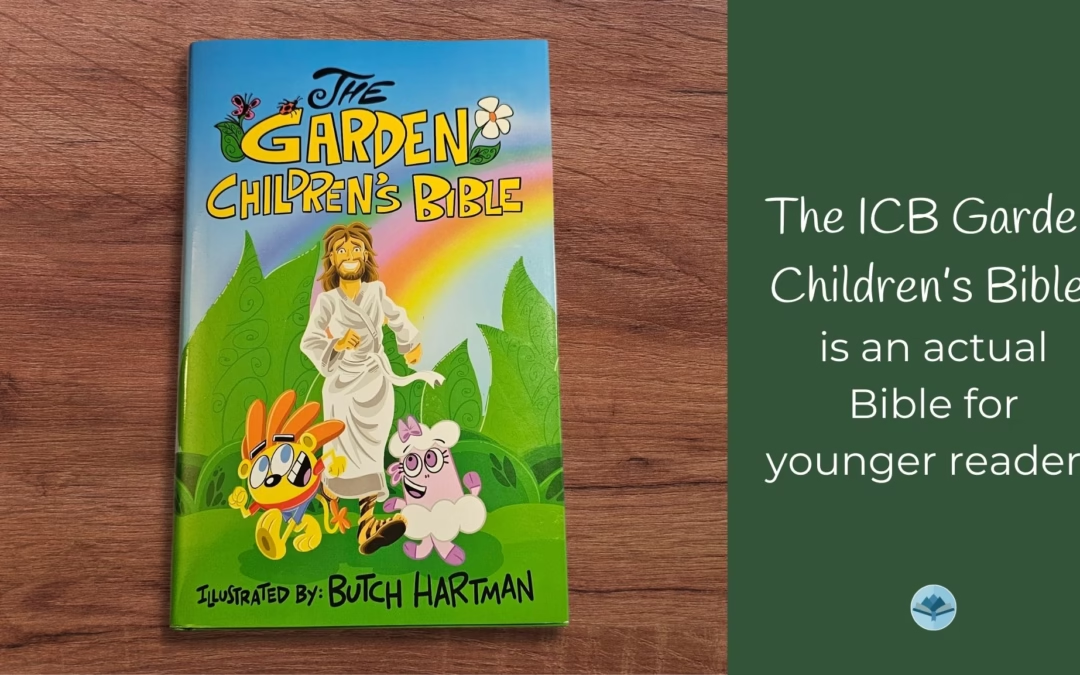
The ICB Garden Children’s Bible is an actual Bible for younger readers
I recieved a free copy of this Bible as member of the Bible Gateway Blogger Grid and as a Bible Gateway Partner in exchange for an honest review. #BibleGatewayPartner
To start right off, I want to say honestly that upon receiving this children’s Bible I was immediately skeptical. One thing that really bothered me as a mom when I was looking for my kiddo’s first Bible was that all the Bibles for littles were not actually the Bible – they were watered-down versions of some of the Bible stories mashed together in a book called a children’s Bible. As she has gotten older and is reading the actual Bible in a variety of translations on her own, she is realizing how little of actual scripture she really read and learned from her Children’s Bible. So, I review anything labeled “children’s Bible” with extra scrutiny and the ICB Garden Children’s Bible is no exception.
So, now that we have that disclaimer out of the way, all you people shopping for a possible Bible for the kiddos in your lives – you can breathe a sign of relief. The ICB Garden Children’s Bible is a full Bible rather than the typical paraphrase children’s Bible we see on bookstore shelves or online. This particular ICB Garden Children’s Bible is not such a watered-down, not-even-really-scripture “children’s Bible”. It is an actual Bible in a translation diligently translated for an honest (and tested) 3rd-grade reading level.
What translation is the ICB Garden Children’s Bible?
The ICB Garden Children’s Bible is offered in the International Children’s Bible (ICB) Translation. I was impressed and encouraged to see that this Bible for kids even has an entire section about the translations. As a parent and avid Bible studier myself, I love being able to read about the translation right here in the Bible and appreciate this courtesy in a Bible for my child.
The ICB was put together by a group of Bible scholars and translators, as well as the World Bible Translation Center. Some of the same people that worked on the ICB also worked on translations such as the NIV, NKJV, and NASB. It uses Greek and Hebrew texts, a couple of which include the 3rd edition of the United Bible Societies’ Greek texts, Biblia Hebraica, and the Septuagint. I find it encouraging that a children’s translation of the Bible was composed using actual Greek and Hebrew texts like most of the more “adult” translations.
This translation is also designed to be true to the original texts in words that anyone at a 3rd grade reading level can easily comprehend. Another bonus I love here is that even when some words don’t translate well into 3rd-grade level words, the more literally translated words are still used and then a dictionary is provided to help readers learn those more challenging words and their Biblical meanings. Not only can your kids now read the actual Bible in a translation designed for them, but they can also expand on their vocabulary while doing so all in the same book.
One thing parents and guardians reading this with their kids will want to notice and assist with is that in more mature translations we see a lot of rhetorical questions that are easier to understand as you get older. Here, they are changed to a statement to relay what the rhetorical questions are making a point about. So, in your own Bible you may see something as a question, while in this Bible it is a statement. You may also see a figure of speech in your Bible translation, while in the ICB it is clarified. This is to help our kiddos read what is being said rather than getting confused by the rhetoric and figures of speech they do not quite understand yet. This may be a hot point for some people, and you will want to pay close attention to these instances, but so far the ones I have seen make complete sense to me.
What makes the ICB Garden Children’s Bible different from other kids’ Bibles?
Aside from it being an actual Bible translation, the ICB Garden Children’s Bible also definitely caters to younger readers in its designs. It features two cartoon characters, a lion and a lamb. My first instinct on seeing this was – why on earth are there cartoons in this Bible? This was another red flag for me.
At the very front, the illustrator gives a great explanation to the reader about these characters. It is explained that these little characters, Lenny the Lion and Lucy the Lamb, encourage the reader to spend time with God and essentially help encourage young readers to be engaged with scripture. These characters help make it entertaining while remaining true to the focus of Jesus Christ. I was very pleased about this, and to be honest completely surprised.
What features are included in the ICB Garden Children’s Bible?
There are also some fantastic resources to encourage children to read the Bible and actually explore Bible themes deeper. Some of these features honestly make this Bible feel more like a grown-up Bible with cartoons on it than a Children’s Bible – but in a way I am really, really grateful for! I don’t want my kid’s Bible to be so milky she is not even learning actual scripture or about salvation and a personal relationship with the Lord. With this, I am not worried about any of those things.
Some of the other features include:
A “Why should I read the Bible?” page
Names of God with verse references
Miracles of Jesus page with verse references
Kids in the Bible page with verse references
Bible illustrations and a whole list of them with page numbers and verse references
Book introductions
Commentary from “Lucy” and “Lenny” to help explain different things found on a page
Highlights about what God says that stand out to the reader
“I can memorize scripture” section to teach kids how to start memorizing scripture
Topical Index
Bible reading plans
Inside front and back cover coloring pages
Is the ICB Garden Children’s Bible a good Bible for younger readers?
Yes! The ICB Garden Children’s Bible is a great Bible for young readers. I do recommend this Bible for children and those at a 3rd-grade (or so) reading level, or even lower with help. This is one of the most thorough children’s Bible I have ever seen that does not skimp on the resources and features just because it is for kids and those at lower reading levels.
The content is well-designed, and the illustrations help readers focus on Christ and learn what the Bible is actually teaching them. I definitely recommend that when a reader surpasses 3rd-or-so-grade reading level they move up to a translation that is at a higher reading level and that is more literally translated, but this seems to me like a wonderful option for families who want their kids to learn to really read and study the Bible at a younger age, as well as for other readers who are not quite ready for the higher-reading level translations. I would recommend this over a paraphrase any day!
Where can you find your own copy of the ICB Garden Children’s Bible?
There are many Bible study tools and methods out there and it can be challenging to decide which method is right for you and each study you dive into. One tool I have found incredibly helpful for studying the Bible is the Thompson Chain-Reference Bible. This helpful resource comes in several translations of the Bible. The NKJV is a wonderful literal translation that has been updated with more modern English, and the KJV offers a slightly different feel with its older English. It also comes in other popular translations such as the ESV, NIV, and NASB. With more than 8,000 topic chains and over 100,000 total references, the Thompson Chain-Reference Bible allows you to follow a topic all throughout the whole Bible and explore topics in scripture more thoroughly.
Easy-to-understand chain-reference system with over 100,000 references
Alphabetical and numerical indexes highlight study materials for over 8,000 topics, each with its own topic number, for exhaustive topical study
An extensive study resource section includes biographical sketches, illustrated studies of the Bible, a concordance, Bible harmonies, and many other helpful study tools
Fresh, two-color page design
66 book introductions
16-page full-color map section with map index
Line-matched text for enhanced readability
Words of Jesus in red
Two double-sided satin ribbon markers, each 3/8-inch wide
Exclusive KJV Comfort Print typeface
Print size: 9.5
This extensive Bible study tool not only comes in several popular Bible translations, but it also comes in a variety of cover options, as well as with and without thumb indexes. The resources within the Thompson Chain-Reference Bible are well organized, and I appreciate the cleaner, easier-to-navigate feel of the newly revised KJV translation of the Thompson Chain-Reference Bible.
Thompson Chain-Reference Bible is a challenge worth accepting
When I first received a Thompson Chain-Reference Bible it was such a unique study Bible that it took me a while to navigate. I immediately saw its value and knew it would add a lot to my Bible studying and was determined to figure out how to get the best use out of it.
The Thompson Chain-Reference Bible has a learning curve - there is no getting around that. I recommend grabbing your own copy and spending some quality time getting to know it. In the meantime, I want to take some time to teach you how to get started with it to help you decide if this is a Bible study tool you want to add to your bookshelf.
Learning a new Bible study method can be a challenge, and for some of us it is daunting. While learning to use the patented chain-reference system is no exception, this is a challenge well worth accepting and taking full advantage of. Let's explore how to use it to help you decide if the Thompson Chain-Reference Bible is right for you, and to help you navigate it if you have your own already and are wondering what to do with it.
How to use the KJV Thompson Chain-Reference Bible
No matter the type of Bible study you are doing, the Thompson Chain-Reference Bible is sure to be a welcome addition that will help you grow in your faith and relationship with the Lord, as you grow in your understanding and application of His Word.
The primary method of using the Thompson Chain-Reference system is through Topic Numbers. Along the margins on each page of the Bible, there are topics listed next to passages within that topic. Toward the back of the Bible, after the book of Revelation and a handful of other helpful study tools, there is Numerical Index of all of these topics.
Start with the Numerical Index
Using the Numerical Index you can search for the topic you would like to study and then find the passages that correlate with that topic. To learn how to do this, let's use the topic of Prayer to give it a try using the newly revised KJV Thompson Chain-Reference Bible.
Notice that within the Prayer category in the Numerical Index, there are quite a few sub-categories that cover Prayer. You can use these subcategories to further narrow down your search and study a more specific niche in scripture.
Within the entire Prayer category, locate the specific sub-category you would like to study. We will look at Prayer Postures for this example.
Once you have located the verse in the Bible's pages, look at the margins right next to the verse. You will see the sub-category "Bowing" with the Prayer Category Index Number, 2829. Right after this, you will notice a different verse listed. This is the next verse in this particular Bowing Prayer Posture chain.
Next, head to the next verse in the chain, which in this instance is Exodus 4:31.
In this next verse of the chain, the reference in the margin directing you to the next link in the chain is 12:27, indicating that it is also within the current book of Exodus.
To continue locating and studying the passages within this chain, you just continue to follow along these chain links in the margins to find the next passages.
Start with a verse or passage
Studying the Bible based on a specific topic you already have in mind to delve into is not always what you are looking for. Another option is to begin with a verse. To learn this method of studying using the KJV Thompson Chain-Reference Bible, we will head to page 1175 and find Matthew 28.
Studying an event throughout scripture
Once you locate Matthew 28, check out the chain reference in the margin. There is a red reference that says "The Resurrection of Christ". This is followed by several verse numbers, each in one of the gospel accounts. If I am reading through the gospels of Jesus and want to easily locate the passages in the other accounts that line up together, I would be able to find these kinds of references and follow their chains. Starting at Matthew 28, I can find all of the gospel passages that tell about the Resurrection of Jesus.
From Matthew, I can head to the coordinating passage starting at Mark 16:1, then Luke 24:1, and finally John 20:1 and read each account of the Resurrection consecutively. This would work for a study such as chronological gospels, and I could also use it as I am reading any passage in which I want to explore more relevant scriptures on the same theme.
Studying a topic throughout scripture
To use the chain-reference system while you are reading any passage in the Thompson Chain-Reference Bible, let's go back to page 1175 and locate Matthew 28 again. Next to verse 16, where Jesus begins giving the Great Commission, the verse begins with "Then the eleven disciples went away...". Lets look up who the 11 disciples are, and read more passages about them. On the right-side margin next to this verse there is a chain-reference which says "Apostles' Names 2081". This tells me that there is a chain of references for the Apostles names, and the Numerical Index identifier is 2081.
From here, I could head to the Numerical Index and find number 2081. Once there, I can find a list of verses that tell me about the Apostles names. I can also find other types of passages that have to do with the apostles. There are additional sub-categories here such as general references to them, and then passages about apostles being called to do special work. The chain-reference system allows me to dive into whatever specific theme I want to explore deeper.
Other ways to use the Thompson Chain-Reference Bible
Using the Numerical Index in one of the ways explained above is how I recommend beginning your adventure with this incredible Bible study tool. With that said, the Thompson Chain-Reference Bible not only utilizes these methods for studying the Bible, but also offers a handful of other helpful Bible study tools and resources. Among these tools are character profiles for studying Bible characters more specifically, detailed explanations of major Biblical journeys, such as Moses, the Israelites, Jesus's life, Paul's many ministry journeys, and more. Additionally, there are a plethora of helpful maps, Messianic prophecies and their fulfillments, unique book and Bible history overviews, and much more.
Within the pages of the Thompson Chain-Reference Bible you will find an impressive toolbelt of resources to take your Bible study deeper, helping you to draw closer to the Lord and what He wants to reveal to you through His Word.
How have I personally used the Thompson Chain-Reference Bible?
Some of the ways I have personally benefited from using the Thompson Chain-Reference Bible are as follows:
Creating Bible reading plans. Many of our free Bible reading plans were made using the chain-reference system to help me find the right verses for the topic of the reading plan. You can make your own Bible reading plans using the Thompson Chain-Reference Bible as well!
Book Overview Studies. I have definitely benefited from the Book and Bible character overviews in the Thompson Chain-Reference Bible and have used them when doing my Book Overview studies for the blog and printables.
Character Studies. When I want to know more about a character in the Bible, I will use the character profiles in the Thompson Chain-Reference Bible as one of my key resources. In 2022 I studied Jesus in depth all year long, and this year I am revisiting the Epistles of Paul at a deeper level and the information in this Bible is incredibly helpful to understanding their journies and the chronology of many different events.
There are many other ways I have used the Thompson Chain-Reference Bible, and I am sure there are many more ways I will use it over time as well. It has transformed my Bible study time and helped me launch deeper into the Word. It has actually been a really helpful stepping stone, taking me from basic surface-level reading and studying into deeper waters of what the Word of God is saying and means. If you are looking to take your Bible study deeper, I cannot recommend this Bible enough.
Who would benefit from the Thompson Chain-Reference Bible?
If you are ready to dive into the meat of scripture and further quench your thirsty soul with a deeper understanding of the Bible, then the Thompson Chain-Reference Bible is for you. The KJV is a wonderful option, and there are several other translations available for you to choose from.
If you would like to get a copy of the Thompson Chain-Reference Bible, you can do so at the following locations online. I highly recommend it to help you take your time in the Word to the next level.
How the Matthew Henry Daily Devotional Bible encourages a daily Bible routine
Getting into a routine reading the Bible can be a challenge even for believers who are well experienced in reading scripture. It is easy to fall in and out of the habit, and make excuses for not making time for the Lord. I suspect we are all guilty of this to some degree, at one point or another. Sometimes we need some structure and motivation, and often times the more convenient the better. The easier the structure is to follow, the more likely we are to adhere to it. This is why the Matthew Henry Daily Devotional Bible is so helpful.
The Matthew Henry Daily Devotional Bible is a Bible in the New King James Version (NKJV translation), published by Thomas Nelson, that includes a daily devotional for every day of the year. It has an annual list at the beginning of its pages that provides the page number for each day's devotional, which allows you to begin at any point in the year.
What makes the Matthew Henry Daily Devotional Bible special?
There is a wide variety of devotional-style Bibles, and it can be challenging to choose one or even determine if a devotional Bible is right for you. They are an incredible tool that can truly help you make a habit of reading the Bible every day, but some designs come with some challenges that discourage and overwhelm Bible readers.
Some of the main concerns regarding devotional Bibles:
Devotional Bibles are usually difficult to start anytime during the year.
Devotional Bibles are difficult to keep up with.
Many devotional Bibles are annual plans that walk you through the entire Bible, making it difficult if you miss a day.
Some devotional Bibles are strategically scheduled so that you will benefit most by reading them in order, again making it difficult if you miss a day.
The Matthew Henry Daily Devotional Bible is a rare gem and the publishers seem to be quite in tune with these common complaints since this particular devotional Bible answers these concerns so well. The Matthew Henry Devotional Bible provides a list of pages assigned to each day, and the readings bounce around the Bible. Sometimes they are consecutive, and sometimes they go from the New to Old Testament, or vice versus. The devotionals also pinpoint a certain verse or a couple of verses rather than a whole chapter or longer passages, but they are within the pages of the verse for that day making it convenient and natural to read as much or little of the passage as you feel led through.
I have been going through the devotions for several days since I received my copy in the mail and have already missed a couple of days, but it was incredibly easy and not overwhelming to go back in and catch up on the days I missed. I also felt like I could just pick up on the day I came back, and knew I could go through the missed days at any time.
Some of the features of the Matthew Henry Devotional Bible that tackle the primary concerns about devotional Bibles:
Light, yet deep and convicting, devotionals focusing on a single verse or a couple of verses, rather than longer passages and chapters each day.
Devotionals bounce around the Bible, making it easy to jump in on any given day and catch up in whatever way works best for the reader.
Devotionals are in line with the verses for the day, making it convenient and natural to read as much or little of the passage as the reader desires.
A dated list with page numbers makes it easy to mark off the days the reader has completed each devotional.
Two ribbon bookmarks make it easy to mark your current day, and maybe tomorrow's devotional, or even a missed day or a particular day you want to go back to.
Who is the Matthew Henry Devotional Bible for?
I am someone who loves studying the Bible. I have a bookshelf full of many different Bibles of many types and translations. I use each for a different purpose and recommend each of them to different people for different needs. The Matthew Henry Daily Devotional Bible is one I expect to recommend quite frequently to a variety of Bible shoppers.
I recommend the Matthew Henry Devotional Bible for people who:
Want to make a habit of reading the Bible every day.
Read the Bible often, but are looking for a structured long-term plan for personal daily devotion.
Are new to reading the Bible completely and are not sure where to begin.
Have been reading the Bible for years but want something light to start their day with.
Looking for a Bible reading plan that will give them a starting point that is easy to go deeper with.
I do NOT recommend the Matthew Henry Devotional Bible for people who are looking for:
A study Bible with notes and commentary throughout the Bible.
A journaling Bible with lots of places to write your own notes within the Bible pages.
A standard Bible with no additions included.
An in-depth devotional that takes you through lengthy passages every day.
A Bible-in-a-year style devotional.
Where can you get your own Matthew Henry Daily Devotional Bible?
The Matthew Henry Daily Devotional Bible is a wonderful addition to anyone's Bible collection and can be helpful and encouraging for new and seasoned Bible readers alike who want to make reading the Bible a daily routine. While it does not suit every need, it is by far my favorite devotional Bible I have used so far and look forward to continuing to use it over the next year.
I received a complimentary copy of the NET Eternity Now: The New Testament Series as a member of the Bible Gateway Blogger Grid in exchange for an honest review. You can find even more information here, and I'd love for you to check out the Bible for sale here. #BibleGatewayPartner
Transform how you read the Bible with Eternity Now
Do you ever have a hard time reading the Bible?
Have you ever wanted to read the Bible without the distraction of awkward verse numbers?
Do you love to read novels, but just can't seem to stay focused when you try to read scripture?
This wonderful series is a composition of all of the books in the New Testament, but in novel form. You can read the Bible and just get right down to it. No extra fluff, no confusing numbers or sentence breaks, just scripture cover to cover (to cover, to cover, to cover, to cover…because there are five books in the set!)
How does Eternity Now get all of those Bible books into novel form?
People have put a lot of work into translating and organizing the Bible so that Bible readers can more easily read and understand it, locate passages, reference verses, and even memorize scripture. All that man-made organizing can often be distracting, though. It can also cause us to forget that all those reference numbers, titles, passage breaks, and other methods of organizing the Bible were put there by people and we can get a bit finicky about how verses are quoted and referenced.
The Bible is God's continuous story of creation, redemption, and eternity and this is important for us all to keep in mind as we read and strive to understand God's Word. Eternity Now puts the New Testament books into paperback novels that make sense to go together based on common themes and reads as a continuous story like you would read your favorite novel series. It also comes in Kindle form for those of us who like to read on our devices.
The books of the Bible are put together in the following five novels:
Eternity Now comes in the NET translation, which is easy to read but still true to the message of the gospel. It is a translation that is growing in popularity and in other NET Bibles, you can even get all the notes and commentaries the translators had when putting it together, which is pretty incredible! (Look for an NET translation breakdown to come).
How can Eternity Now transform how I read the Bible?
Eternity Now is fantastic for anyone wanting to draw closer to the Lord and gain a deeper understanding of His Word with fewer distractions. The ability to more easily read the Bible in raw form is incredible. I love to read, and I spend countless hours reading the Bible as well as other books. With this, I can throw one in my bag and take it with me anywhere, and even imagine better what it would be like to be in the story like I can do so easily with novels.
Eternity Now is also a great way to recommend the Bible to others who may be intimidated by reading a standard Bible. Someone who may not even consider picking up a standard Bible may grab a copy of Eternity Now and read the Bible for the very first time. This is a powerful tool for us to share the gospel in a way more people will be drawn to participate in.
You can also take your annual Bible-in-a-year reading plans to a whole new level and not feel left behind. With clear-cut novel layouts, reading the entire New Testament is not a daunting task anymore with Eternity Now. I don't know about you, but I have started MANY annual Bible reading plans. I have completed it a couple of times, but it was a lot to tackle. This can definitely help us tackle the New Testament all the way through.
Do I recommend Eternity Now?
I recommend Eternity Now to anyone who enjoys reading novels, wants to read the whole New Testament all the way through, wants to recommend a less daunting way for others to read the Bible, as well as for those who want to read the Bible with fewer distractions and just get down to God's Word more seamlessly.
How can the NET Young Women Love God Greatly Bible help young women grow closer to the Lord?
The NET Young Women Love God Greatly Bible is a Bible specifically designed for young Christian women who want to grow in their faith and relationship with the Lord. It has many wonderful and unique features that encourage young women to explore scripture deeply and read and engage with God's Word often. This beautifully designed and laid out Bible was made with the goal of encouraging young women to love God greatly by studying His Word and knowing His character.
The NET Young Women Love God Greatly Bible starts out by providing some vital truths all Christians should stand on and believe. It talks about God's love, our sin, Jesus' sacrifice and resurrection, and what it means to accept Jesus as your savior. This is at the very beginning, helping readers to know these truths so that as they read the Bible they will have these truths to hold onto and guide them throughout God's Word.
Information about the spread of the gospel in various countries and how to pray for them
Reflection and challenging questions to get readers thinking more deeply about the scriptures
Encouraging devotions
Maps and timelines
Mentor letters from seasoned women of faith
Profiles and testimonies of various faith heroes throughout history
Verses in the margins that focus on God's heart
What is the SOAP Bible Study Method?
One of the most unique features of the NET Young Women Love God Greatly Bible is that it puts emphasis on using the SOAP Bible Study Method. This is a very popular method of studying scripture that is designed to help Bible readers dive in deeper to discover the meaning of what they are reading.
SOAP stands for Scripture, Observation, Application, and Prayer. In the NET Young Women Love God Greatly Bible there is not only a full explanation of the method, but each book of the Bible includes a special reading plan after the overview. The reading plan includes a chapter-by-chapter plan to guide you through the whole verse, but also offers a suggested focus verse to use with the SOAP Method.
Using these reading plans is a wonderful way to learn how to read and study the Bible because you are given reading plans to read through the whole Bible, each book, and various topics, but also in tandem given a Bible study plan as you read it. You are also encouraged and taught a method of incorporating prayer into your Bible reading and studying. This encourages readers to go beyond reading and begin learning and applying what it says. This method encourages young women to truly engage with God's Word and grow in their love, understanding, and relationship with Him.
One thing I have been teaching my kiddo is that when you have learned one method of doing something well, you then are better equipped and have a better understanding of how to do it well in a different way. Learning a preformed method of studying the Bible that has been helpful and successful for others can give you a better grasp on how to read and study the Bible more deeply in other ways. Even if the SOAP Method is not what you want to stick with it is a wonderful teaching tool to help you understand how to study scripture more deeply and prayerfully and help you to grow in your relationship with God.
Who is the NET Bible translation designed for?
The NET Bible translation is acclaimed to be the newest English translation of the Bible. This is a new translation to me personally, but I am excited about a couple of particular highlights this translations is unique for. While the NET was being translated, the editing was actually made public worldwide for people all over the world to participate in the process by reviewing and offering questions and comments about each draft before it was finally published in 2005. It was then given another update in 2019.
Bible scholars, ministers, and laypersons around the world helped in the editing process helping the NET translation to become not only the newest, but claiming to be the most accurate because of all of the feedback that helped it to become what it is. While the NET Young Women Love God Greatly Bible does not have commentary notes included outside of the many types of articles and testimonies, there are more than 60,000 notes available online and in many other print copies of the NET Bible. Many of these notes document the challenges of translating into English which helps readers to better understand translation decisions and alternative word choices. The NET is also much looser on copyright, desiring to make it easier for people to use and share it in a variety of ways.
Can the NET Young Women Love God Greatly Bible help young women read and understand the Bible?
I personally find learning about various translations incredibly valuable when choosing a Bible. It is important to know who translated it, why they translated it, and what methods and sources they used. This can help Bible readers determine if a particular translation is right for them, if it is better as a companion or a primary Bible translation, or if it is not what they are looking for at all.
The NET Young Women Love God Greatly Bible is a wonderful translation for women at any stage in their Bible reading experience and can be truly valuable as a companion or a primary. It is easy to read and understand, and has a great balance between thought-for-thought and word-for-word. This Bible would definitely be a helpful translation, and the NET Young Women Love God Greatly Bible a helpful Bible for young women to better understand the Bible.
With the combination of the NET translation, the many wonderful resources and features, and the gorgeous layout and wide margins, the NET Young Women Love God Greatly Bible is a Bible that helps young women to discover and dive into new and deeper perspective throughout scripture. This will help them learn and understand God's Word better and grow in their faith and relationship with the Lord.
Do I recommend the NET Young Women Love God Greatly Bible?
Overall, this Bible is an exciting, fresh, new Bible I am extremely pleased to own and have as a resource for my Bible reading and studying. I am anxious to recommend this particular Bible and strongly recommend it for women just beginning to read the Bible, learning how to study the Bible, as their new daily Bible, and even to help you read through the whole Bible for the first time or even if you have read through it many times before. No matter how experienced you are with reading and studying the Bible the NET Young Women Love God Greatly Bible would be a fantastic refreshing addition.
Where can I buy the NET Young Women Love God Greatly Bible?
You can find this Bible at the following locations, and more.
Can Spurgeon and the Psalms help me understand and apply the psalms to my own life?
The NKJV Spurgeon and the Psalms is a beautiful book of the Psalms that coordinates many of Charles Spurgeon's sermons with the Psalms of scripture. At the beginning of every Psalm is a sermon passage from Charles Spurgeon's notes that helps to explain that psalm for the reader. NKJV Spurgeon and the Psalms is a great tool to help those who wish to read through the Psalms make a habit of reading them regularly, and aids in the reader's understanding of the Psalms.
This book comes in the NKJV translation, which is a great translation to read alongside commentary from Charles Spurgeon. Charles Spurgeon is known as the "Prince of Preachers" and lived in the Victorian Era from 1834-1892. He is well known for exemplifying Christian virtues in life and ministry, and his sermons are commonly referenced even still today. His Victorian Era preaching style combined with the elegance of the NKJV translation and the teachings of the Psalms is a powerful combination for any Bible reader to enjoy and learn from.
Reading the Psalms alongside sermons from the Prince of Preachers is a wonderful way for Bible readers to gain a deeper insight and understanding of the many teachings and themes throughout the Book of Psalms in the Bible. Charles Spurgeon was passionate and did not hesitate to teach aboutsalvation through Christ, and help his congregation, and therefore many generations to follow, the importance of full dependance and faith in Christ alone.
His teachings have truly helped me gain a deeper grasp on scripture through NKJV Spurgeon and the Psalms as well as his other works, such as his sermons and a helpful Spurgeon Study Bible. His teachings are always scripture and Christ focused, drawing Bible readers and sermon hearers to the Truth of Jesus. I greatly enjoy learning more about God and His Word with the help of Charles Spurgeon's sermons and commentary.
Can Spurgeon and the Psalms help me get into a habit of reading the psalms?
Not only have I enjoyed reading NKJV Spurgeon and the Psalms and other Charles Spurgeon resources, but NKJV Spurgeon and the Psalms is a wonderful way to get into the habit of reading the Psalms daily. Having this lovely little leatherbound book of Psalms with a bright blue ribbon bookmark conveniently packaged with Spurgeon's commentary at the start of every Psalm makes it easy to use the book as a sort of Bible reading plan. It is a great book to use for daily devotionals in a morning Bible routine, or even a bedtime scripture story with your family or on your own.
Do I recommend Spurgeon and the Psalms?
I highly recommend NKJV Spurgeon and the Psalms to all who have an appreciation and knack for absorbing Victorian Era language and wish to form a habit of reading the Psalms. It is a fantastic resource for helping Bible readers gain a deeper understanding of the Psalms and from there navigate better how to apply it to one's own life. The Christ-centered sermons of Charles Spurgeon are sure to encourage and enlighten anyone seeking to understand God's Word more personally and to grow in their faith and relationship with the Lord.
Amazing and colorful pilot pens that are fun for notes and art journaling
Sticky notes and lined sticky notes for extended notes to save in my Bible. Margins can only fit so much! And great for when I go back and study something again. Add a sticky note with your new notes on it!
Can the NIrV Journal the Word Bible for Girls help my child read the Bible?
The NIrV Journal the Word Bible for Girls is a journaling Bible intended for children and people learning to read, beginning Bible journaling, and verse tracing. There is a whole line of Journal the Word Bibles available and the design of each is to make space for your preferred style and method of journaling while reading and studying the Word of God. These Bibles are intended for creative Bible journaling, art journaling, general note-taking, bullet journaling, and verse art. The Bible text is in the NIrV Journal the Word Bible for Girls is a double-column format and sits next to a generous 2-inch journaling margin.
While I sincerely appreciate the amount of margin space given, there is much more to consider when shopping for your next Bible, or for your child's first journaling Bible. One of the first questions we should ask when choosing a Bible, and particularly so when choosing a Bible for our children, is whether the translation and the commentary are Biblically accurate. With this, I appreciate that the NIrV Journal the Word Bible for Girls gives us an in-depth explanation of the translation used.
What is the NIrV Bible translation?
The NIrV Journal the Word Bible for Girls comes in the NIrV, or New International Reader's version, Bible translation. This translation is written at a third-grade reading level. It is based on the NIV Bible translation, and uses much of the NIV text but with some updates with the goal of making the Bible easier to understand. Some updates to this translation include shortening and simplifying words and sentences, breaking up sections into smaller paragraphs with more identifying headers, and adding verse references right after a verse that is quoting another verse of the Bible.
The translators for the NIrV used the oldest copies available of the Greek New Testament and the Hebrew Old Testament. With this, there are some passages that were not in these older documents that were added in later documents, and the NIrV leaves these verses out. While the verse is omitted, the verse numbers are lumped with the previous verse to indicate that some translations include another verse at that point.
Who is the NIrV Bible translation designed for?
Children who read at a 3rd-grade reading level
Adults who are learning to read
Those whose first language is not English
Those who have a hard time understanding written information
Those who are reading the Bible for the first time
Is the NIrV translation helpful for kids learning to read?
You can find my review about the NIV translation and some additional insight in my review of the NIV Radiant Virtues Bible, but in short, I always encourage Bible readers to not use the NIV translation as their primary or only translation, and I encourage the same for the NIrV.
I appreciate that the NIrV helps make it easier for those learning to read or with reading disabilities to read the Bible. The process, however, ends up drastically changing words and sentences which can alter the tone and message of what is being read. This is a thought-for-thought translation, and there are many differences in how the NIrV and NIV word things in comparison to word-for-word translations and translations such as the NKJV translation, and especially in comparison to the original Hebrew and Greek which are much more poetic in nature and tone than our modern English.
Overall if you are reading the Bible at all that is a big deal and a big win. The translation does matter, and this is a translation I would advise each reader to compare and companion with a literal or word-for-word translation as they advance in their experience reading the Bible.
Can the NIrV Journal the Word Bible for Girls help kids read the Bible?
The thing about journaling Bibles is that often times the translations are the more thought-for-thought, modern language style translations. This tends to make it easier for a lot of people to turn a verse into Bible art. I use my NLT Inspire Creative Journaling Bible every morning, and this NIrV Journal the Word Bible for Girls is very similar. In fact, the NIrV Journal the Word Bible for Girls is cleaner and leaves even more space for getting creative or taking well-organized notes.
This journaling Bible is a great option for people of all ages who want a simple, clean-cut journaling Bible. This journaling Bible is fantastic for someone who wants to learn and practice Bible journaling, and creative Bible journaling. It is not cluttered or prefilled with a bunch of fancy verse art and is extremely easy on the eyes. This can be really helpful for kids who get easily distracted and can also be great for adults who struggle to focus or understand written materials.
There is a lot of space in the margins, some margins are faintly lined and some are blank, and the verses offered in a limited number of the margins are in a simple, accessible, traceable font. This design would be helpful for those with visual disabilities and can allow adults and kids learning to read and write to do so in a creative, God-honoring way. This journaling Bible is well designed for someone who wants to learn to read and write with the Bible.
My copy of the NIrV Journal the Word Bible for Girls is going to go to my daughter who is reading the whole Bible on her own for the first time. She loves to journal and take notes and is excited about the space available and the traceable verses to help her practice her handwriting with Bible verses. She will also be companioning it with her NKJV Thinline Bible.
Do I recommend the NIrV Journal the Word Bible for Girls?
The NIrV should be read as a starter Bible with the goal and intention to move up to a translation that is written at a higher reading level when the reader has advanced to a higher reading level.
The NIrV Journal the Word Bible for Girls is a wonderful option for kids and adults who are learning to read or who have a hard time understanding written information, but as one learns and grows in their literary abilities moving up to a more literal translation will help identify verses that are left out or worded differently, and expand on their understanding of scripture.
Where can I buy the NIrV Journal the Word Bible for Girls?
You can find this Bible and many others from the Journal the Word line at the following locations, and more.
Amazing and colorful pilot pens that are fun for notes and art journaling
Sticky notes and lined sticky notes for extended notes to save in my Bible. Margins can only fit so much! And great for when I go back and study something again. Add a sticky note with your new notes on it!
How Max Lucado's John 3:16 The Numbers of Hope Bible study challenged my faith
Max Lucado's John 3:16 The Numbers of Hope Bible study has been a wonderful blessing. I have done many studies and read many books written by Max Lucado and so far I have not completed one I did not enjoy and was not challenged by. He has a graceful and humble approach while not neglecting to teach about important topics and issues with blunt, unfiltered truth. The Numbers of Hope Bible study, an updated version of the original published in 2007, is by far one of the best I have done altogether, let alone from Max Lucado.
When considering any Bible study there are important factors we all must evaluate. We need to ensure we are learning from godly teachers and examples who are rightly dividing the Word of Truth, and that the way they teach is founded on scripture and in the correct context. We all have a responsibility to filter what we learn directly through the Word of God and not ever just take someone's word for it, and that is exactly how I approached this study and therefore the filter I have used for this review.
Is the 3:16 Numbers of Hope Bible study Biblically accurate?
The very first question we should always ask about any Bible study or Bible teacher is whether a Bible study is being taught in a biblically accurate manner and whether a Bible teacher is teaching biblically accurate lessons. We are instructed to filter all things through the Word of God and to rightly handle the Word of God.
Throughout Max Lucado's John 3:16 The Numbers of Hope Bible study, Max does a great job explaining passages in context. He defines many of the words and phrases within the passages using the original languages in the applicable context, sometimes explaining how the same word is used in other passages of scripture as well to help us understand the meaning throughout scripture. He also provides relevant examples from his life, other people's testimonies, and the testimonies and experiences found in the Bible. He identifies and explains connections between passages, as well as New and Old testament connections to help us understand what we are reading and studying in context and in-depth.
Max Lucado primarily uses the NIV translation throughout this study. I encourage every individual to research the different Bible translations in order to understand the background, sources, purpose, and other key information about each translation they use. It is important to understand how each translation should be used and know how it came about. NIV is a translation I highly recommend using as a companion to other more literal translations. With that being said, the use of NIV should not deter anyone from this study.
Max does exactly what I would do myself, as well as what I encourage others to do - research the original language and use other translations as well to dive into the original context and meaning of the passages being studied. Over-reliance on any one translation, especially without looking back at the original language in the correct context, can easily cause us to miss key information and lack the full understanding God wants to reveal to us.
I am confident that Max Lucado's John 3:16 The Numbers of Hope Bible study has been well researched and is being taught in a biblically accurate manner, in the correct context, and does well to help participants understand complex lessons from scripture. He uses scripture as the foundation and source, and uses examples from scripture and his own and other's lives to help explain.
How did the Numbers of Hope Bible study challenge me?
If a Bible study does not challenge you, it cannot change you. The point and goal of any Bible study should be to challenge the participant and lead them to grow in their faith as well as their knowledge, understanding, and relationship with God. Sometimes a study will reaffirm what you already know, believe, and understand. Sometimes it will provide a fresh perspective, or teach you something totally new. This Bible study by Max Lucado is no exception. Wherever you are on your journey, the Numbers of Hope Bible study will challenge you if you approach the study ready and willing to grow.
Through Max Lucado's John 3:16 The Numbers of Hope Bible study, I have personally been challenged in several ways. Max covers so many vital topics in this 5-week study series that encourage participants to check the conditions of our own hearts, identify sin in our lives, handle idols we have placed over God, and learn the importance of being saved and born again in Christ.
There are so many truths throughout this study that God knew I needed to be reminded of. There are also many truths I needed God to help me understand on a deeper level. The Numbers of Hope Bible study progresses each week to help us understand step by step, word by word, deeper and deeper about what salvation really means and is, where it actually comes from, why we need it, and what we should do in response to it. I absolutely love and appreciate the powerful ways Max explained being saved, being born again, having a hard heart, and the two eternal outcomes for believers and unbelievers.
Max Lucado does not shy away from the topic of sin, repentance, or Hell, but gracefully and lovingly encourages all of us to truly evaluate the reason for our faith and the condition of our relationship with Christ. He challenged me to think seriously about what I know and believe about Jesus, God, salvation, faith, and eternity. He also challenged the way I see myself as a child of God.
One of the main lessons he hits over and over is that Christ is the one with the authority over all of His creation. While I often want to do things my way, His way is always best but my way will lead me away from Him, His promises, blessings, and the hope I have in Him when I am not aligned with Him and His desires.
Max plants seeds all over this study that can leave us thinking about our own ways, hobbies, choices, and condition and whether or not they align with the message of the gospel of Jesus Christ. Not only does this study convict, but it provides and explains the reason for hope, and that is Christ and Christ alone. For anyone with questions, doubts, concerns, worries, or uncertainties this study helps combat them all strictly on the firm foundation of scripture and the hope we have in Jesus Christ as our Savior.
For anyone who does have confidence in Christ, this study identifies so much that we often take for granted and need reminders and encouragement about. No matter if you are a believer, unbeliever, new Christian, life-long Christian, or anywhere in-between this study will leave you with much to consider, pray about, and evaluate in your own life and condition.
How does the Numbers of Hope Bible study apply to my life?
Throughout The Numbers of Hope Bible study, he asks a variety of questions that left me thinking about my own life, faith, and condition. There are many ways this study definitely applied to my own life and that will surely apply to yours as well. Some of the questions I gained or was reminded to ask and pray over are:
What is the true reason for my faith and hope in Jesus?
What am I really doing with my faith?
How do I honestly feel about admitting my own sin and guilt?
How can I share my faith with others more often?
Am I really looking to Jesus as the guide and authority over my life?
What do I really believe about the crucifixion of Jesus and its relevance to me personally?
What do I honestly believe about eternity?
How can I help others know and believe the truth about eternity?
Am I producing good fruits because of my faith?
Do I look at and see other people the way God does?
There are many more ways this John 3:16 Bible study challenged me to apply what I learned to my own life, and countless ways I am sure it will do the same for you. This study will leave you checking your own heart condition, your life, your faith, and your relationship to and with the Lord.
Where to find Max Lucado's John 3:16 The Numbers of Hope Bible study
I am a wife, mom, writer, crafter, and above all, a Child of God. I love to study the Bible, fellowship with other Christians, and serve God. I am thrilled to invite you to join me in seeking to satisfy our thirsty souls with the Living Water of Christ, which is what Water On Thirsty Land is here to do.